
Just in case it's geolocked or stuck behind paywall or anyone:
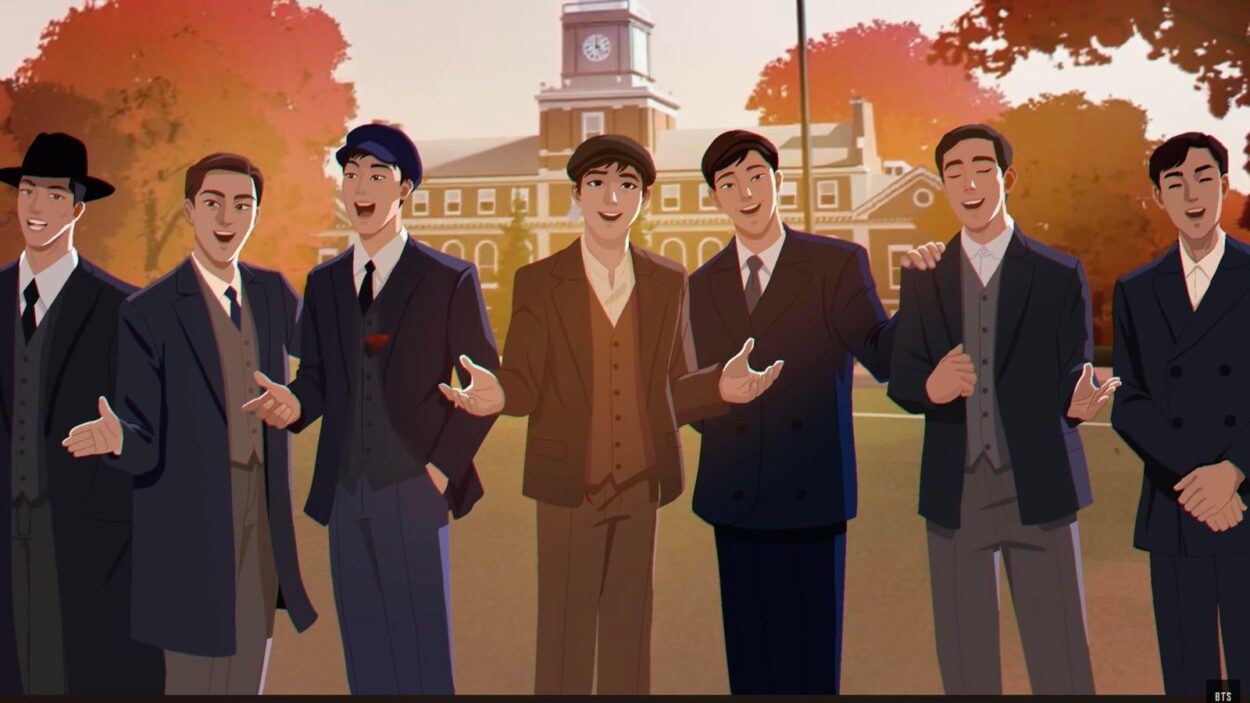
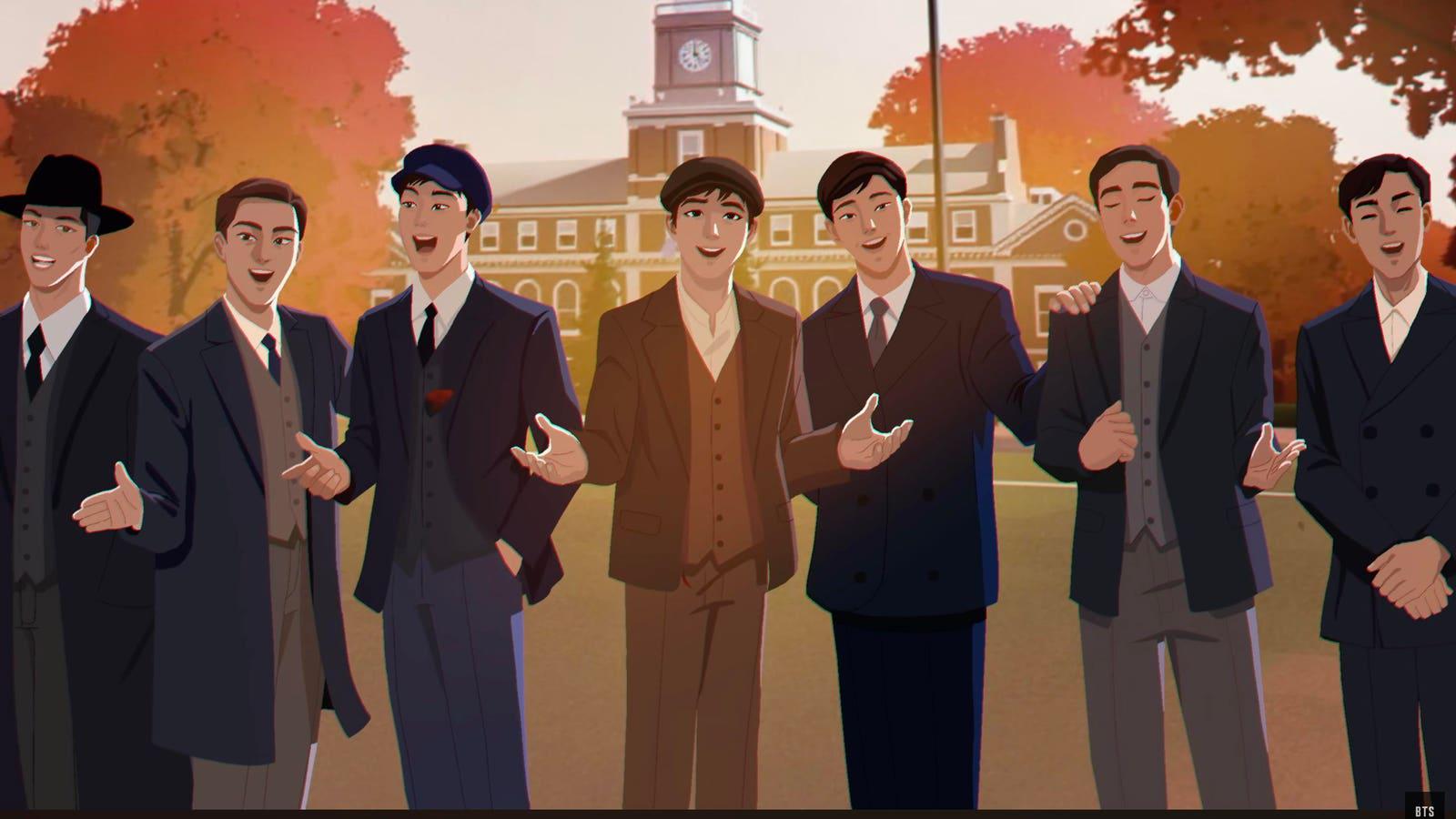
When BTS released the animated trailer for their fifth studio album Arirang on Thursday, the K-pop septet drew on an obscure moment in Korean-American history: seven young Korean men who made the first known audio recordings of Korean voices in the United States in 1896. But who were these students, and why does their story matter 130 years later?
A ‘Wild And Romantic’ Story
On May 8, 1896, The Washington Post published an article titled "Seven Koreans at Howard: Ran Away from Home to be Educated in United States." The byline was sensational: "All are sons of noble families, but do not understand a word of English—will be kept at the expense of the Minister from Korea."
The Post called their story "somewhat wild and romantic," reporting that the young men were "scions of noble families" who had been studying in Japan but "took it into their heads to acquire their education in the United States" instead.
What the newspaper didn’t report — but other records suggest — was considerably more dramatic. According to historian Rayford W. Logan's history of Howard University, cited by researcher Karis Lee, six students had stolen 400 won from a Korean bank in spring 1896 and fled to Vancouver: Im Byung Goo (19), Lee Bum Su (24), Kim Hun Sik (27), Ahn Jung Sik (23), Eyo Byung Hyun (26), and one unnamed student. A seventh joined them at Howard.
Whether these were the same seven students mentioned in the Post article is unclear; the Library of Congress notes that the Korean students who made the recordings were "not related to the coup d’état" and had run out of funds after leaving Japan. What is certain is that by spring 1896, seven Korean students found themselves stranded in Canada and appealed to the Korean Legation in Washington for help.
A Diplomat In Exile Extends Mercy
Suh's decision to help them makes sense only when you understand his own backstory. He was himself a political exile who had fled to America under duress.
Suh had been one of the very first Koreans to visit Washington, D.C., arriving in 1883 as part of the diplomatic mission accompanying Min Young Ik, a Chosun diplomat and minister. After returning to Korea, Suh participated in the Gapsin Coup of 1884, which was an unsuccessful attempt to overthrow the pro-Chinese conservative faction governing Korea. When the coup failed, and Suh fled back to Washington, where he had connections from his earlier visit.
When a reformation movement briefly took power in Korea in 1891, Suh returned home. But by 1896, he was back in Washington again, serving as Korean Envoy and Minister Plenipotentiary, and apparently willing to extend mercy to seven young men whose desperation he likely recognized.
The Post noted cryptically that "Only the minister and the runaways know the precise nature of the correspondence." Suh coordinated with Howard University to enroll the students.
According to Logan’s history of Howard University, on April 29, 1896, Suh personally requested at a meeting of the Executive Committee that rooms be provided for the Korean students. The Committee voted to make rooms available free of charge in Clark Hall, with Suh agreeing to pay for furniture.
Why Howard University?
Howard University, founded in 1867 to educate formerly enslaved African Americans during Reconstruction, became an unlikely destination for Korean students. But in 1896 America, options for international students of color were severely limited. Prestigious Northern universities maintained informal racial barriers. Howard, by contrast, had established itself as an institution willing to educate students who faced discrimination elsewhere.
The Post noted that professors at Howard were "interested in their case" and that the students "will be distributed among the professors’ families during the summer vacation," where their hosts would "coach" them in English. At arrival, the students communicated through "pantomime and what English phrases they have picked up from their journey."
The Singers Who Captured Attention
The few records that remain of the Korean students at Howard suggest they were best known for their musical abilities.
The Post described a social gathering that took place "on the night of their arrival." The Korean men were "solemn, sedate, and observing" and "were surrounded by a dozen persuasive damsels, who begged them to sing." The students said they "could not sing in English, but they were assured that that did not matter." After more urging, 'the programme of ‘Suwanee River’ and like songs was diversified by specimens of real Korean melody."
Alice Fletcher And The First Recordings
On July 24, 1896, just over two months after the Post article, American ethnologist Alice C. Fletcher invited three of the Korean students to her home in Washington to produce what became the first known audio recording of Korean voices and music in the United States.
Fletcher was an established scholar whose work primarily focused on Native American music. According to Library of Congress records, the students who sang were Ahn Jeong-sik, Lee Hee-Cheol, and Son Rong. They recorded six wax cylinders over two days (July 24-25, 1896), including what Fletcher labeled "Love Song: Ar-ra-rang"—the first known recording of "Arirang," the folk song that has become Korea's unofficial national anthem.
One student, Jong Sik Ahn (likely Ahn Jung Sik), performed a song Fletcher transcribed in part: “Not less than 500 years / Out of the valley of many mountains / […] The prayer that all good [illegible] may not grow old / […] In a fine moonlight night in a great / great Anthem Hail his majesty / […] Blooming plum tree / […] older than present dynasty, which is / 500 yrs. and more old…”
The students recorded six wax cylinders that day. Today, these recordings are held by the Library of Congress. In 2017, they were exhibited at the fifth annual Seoul Arirang Festival, returning to Korea 121 years after they were made.
Korea In Crisis: The Context
The timing of these recordings carries historical weight. In 1896, Korea was caught between competing imperial powers. Japan had just defeated China in the First Sino-Japanese War (1894-1895), fought largely over control of the Korean peninsula. In October 1895, Japanese agents assassinated Queen Min. King Gojong fled to the Russian legation in Seoul in February 1896, governing from foreign soil, a national humiliation that underscored Korea's loss of sovereignty.
For the Korean students recording "Arirang" in Washington that summer, their homeland’s crisis was immediate. Full annexation by Japan would come in 1910, but the trajectory was already clear. Preserving "Arirang" on wax cylinder as seen in BTS’ video — capturing Korean voices in a permanent medium — took on deeper meaning as an act of cultural preservation during a moment of national vulnerability.
From 1896 To 2026: The BTS Connection
BTS’s animated trailer, directed by Hur Sungwhe with art direction by Léa Pinto, as well as the album cover draws on the visual language of the 1896 era — formal portraiture, period-appropriate styling, the gravitas of historical documentation. The production credits note it is "a modern reimagining" that "may deviate from actual historical events."
The album cover shows all seven members in formal tailored suits that evoke early 20th-century photography, the kind of studio portraits the Howard students might have sat for. It feels like a deliberate aesthetic choice that positions BTS as inheritors of a tradition of Korean cultural assertion stretching back more than a century.
The parallel is clear: seven Korean students in 1896, seven BTS members in 2026. Both groups represent Koreans preserving culture on international stages. The students recorded "Arirang" while their nation faced extinction. BTS returns to "Arirang" after nearly four years apart for military service.
BTS's Arirang releases March 20, marking their first full album in nearly four years. The 14-track project features production from Pdogg, Kevin Parker of Tame Impala, Flume, JPEGMAFIA, Mike WiLL Made-It, and Ryan Tedder. The group will perform a free concert at Seoul's Gwanghwamun Square on March 21, livestreamed globally on Netflix, followed by an 82-show world tour beginning April 9.
What We Owe The Seven Students
It would take another 60 years for a substantial number of Koreans to immigrate to the D.C. area. But the story of Suh Kwang Bum and the first Korean students at Howard proves Koreans have been making D.C. home longer than most Americans realize, and that American fascination with Korean music predates the K-pop phenomenon by well over a century.
The seven students — runaways, nobles and exiles, singers who charmed "damsels" at Howard social gatherings — left behind six wax cylinder recordings that survived 130 years of technological obsolescence and historical upheaval. Per The Korea Herald, there are more than 60 recognized regional versions and thousands of lyrical variations, all built around the familiar refrain “arirang, arirang, arariyo.”
We likely know some of their names: Im Byung Goo, Lee Bum Su, Kim Hun Sik, Ahn Jung Sik, Eyo Byung Hyun. One remains unnamed. We don’t know what became of them after Howard; some likely returned to Korea, some may have stayed in America. But we know they were there. We know they sang "Arirang" into Alice Fletcher's recording device before any Korean institution thought to preserve it.
Across 130 years, the song endures. The voices change, but the melody, and what it represents about Korean resilience, identity, and cultural assertion, remains.
Note: The above account draws on research by Karis Lee for Boundary Stones, WETA’s local history blog, and the D.C. Historic Preservation Office’s Korean American context study. BTS’ ‘Arirang’ will release March 20, 2026.

![231212 [REWATCH] RUN BTS! Episode 44](https://www.btshubs.com/wp-content/uploads/2023/12/53XnJcToOTsvTDt7288PuqcbRy1-zvtj8ZoIxhoJHJw.jpg)

this is a beautiful article. also interesting that they chose not to list diplo as one of the producers featured on arirang
Those in going to the Baltimore show and those in the DMV area, just a heads up, there are a couple of days between Baltimore and Arlington that the guys might be free. They *might* just drop by Howard in DC to pay their respects. Just sayin’.😉
*DISCLAIMER: Not affiliated with Howard or BTS in ANY way or form. Just another ARMY dutifully putting on her clown suit.🤡
EDIT: Or they may even stop by before the Baltimore stop? 🤔
Love how this highlights Howard and their willingness to take these students under their wing. HBCU’s were/are so important in helping educate minorities, even white women were welcomed in the past as they were still seen as a minority at the current time. It was because of this willingness to take in all minorities and not just Black students by HBCU’s that gave the 7 Koreans the ability to make music. I love how this comeback highlights an HBCU, but wish we had more emphasis on how important this part was in this story. I did really enjoy researching more about Arirang and HBCU’s for the impact they’ve both had.